Lower School
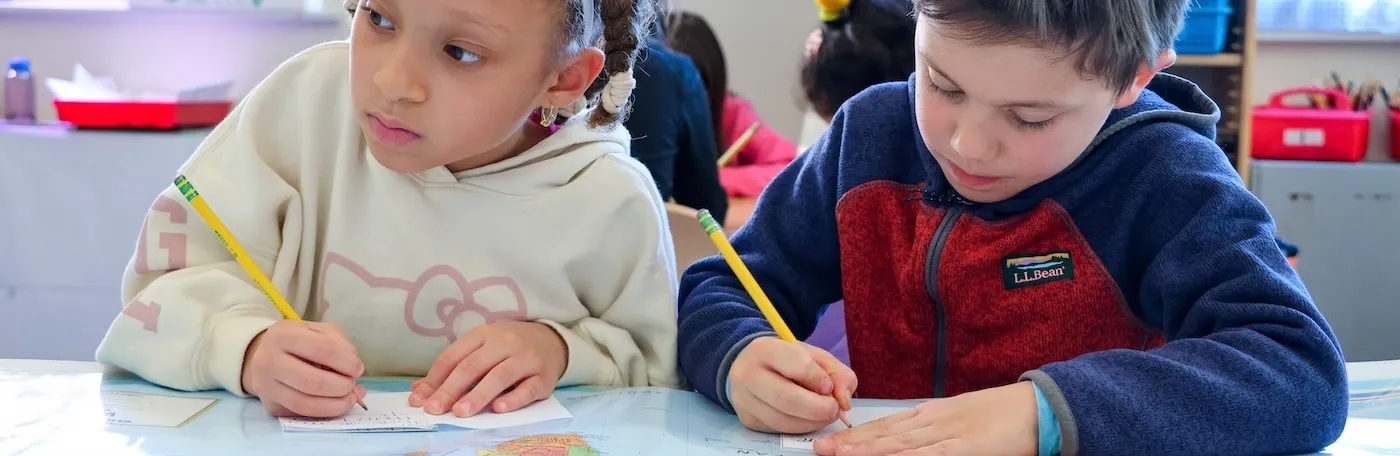
At The School at Columbia, our Kindergarten, Grade 1 and Grade 2 students are learning about themselves, their families and their community. The K-2 program focuses on building a strong foundation for all aspects of learning, and developing skills necessary for school success. We teach literacy, math, and social and emotional learning within the context of a conceptual, integrated, multi-disciplinary curriculum. The commitment to nurturing the young child is reflected in small classes with two or three teachers per class. Getting to know each child well is a priority for teachers in this division. Before the first day of school, each child is invited in for a class visit to meet their teachers and their classmates.
The school year begins with activities that help students build classroom routines and structures, while achieving a sense of community with their classmates and environment. Teachers build relationships with students in a variety of ways, getting to know their interests, personalities, family values, and learning styles in addition to their academic skills through individual assessments of literacy and math. At several points throughout the year, teachers collect data on each student in order to differentiate instruction of foundational academic and social skills for a diverse range of learning styles. Learning objectives for each grade level that are appropriate for the developmental needs of the age are a mainstay of the Lower Division.
We celebrate friendship every day and look forward to shared recess and lunchtime by grade and buddy time with our older-class partners. Beginning with Kindergarten and Grade 4 buddies, buddies read in each other’s classrooms, share projects with one another, go on a hiking trip to Black Rock Forest and host buddies to celebrate the 100th day of school.
Transitioning from Grades K-2 to Grade 3, children are building on the solid foundation of the content and processes they experienced in Kindergarten through Grade 2. The shift of responsibility changes from the hands of parents/guardians and teachers to the students. Teachers scaffold their students toward becoming independent by encouraging children to take ownership of their learning. Our structure reflects this delicate balance we must strike as the bridge from the lower grades to the upper grades. In Grade 3, students have a lead teacher and an associate teacher in the classroom; however, Grade 4 is the first year students have one teacher in the classroom, moving them toward independence. The School works on a ten-day schedule, which, in addition to literacy and math every day, provides time for visual arts, dance, class meetings, music, science, Spanish, spelling and social studies.
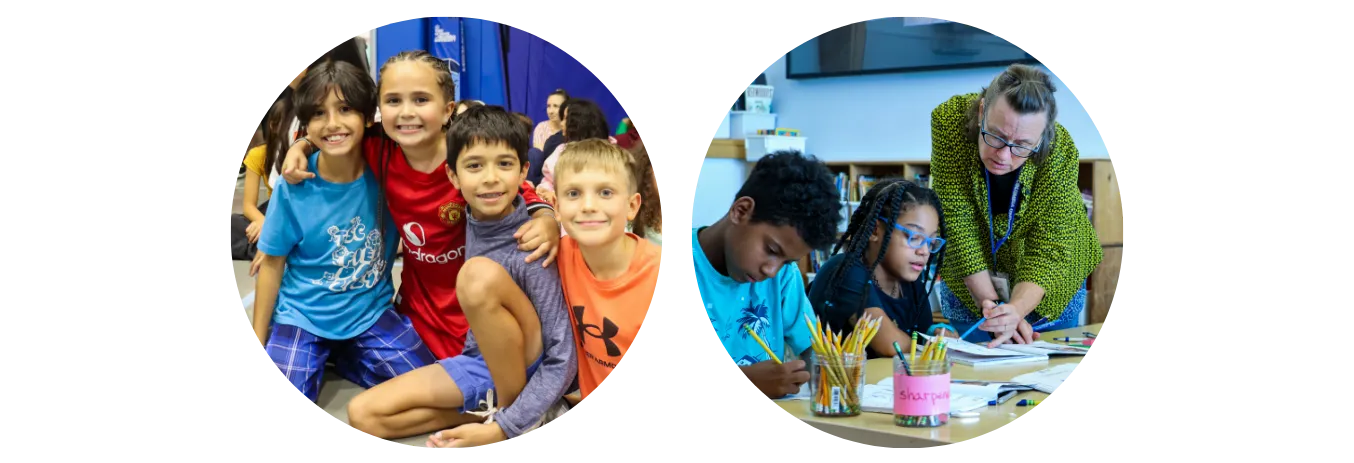
Our academically diverse population requires all teachers to meet the needs of a wide range of students. Our need to remediate as well as challenge our students is imperative to our goal of creating independent, self-regulated learners. Differentiating instruction takes many forms within the classroom. Student needs are determined through ongoing assessments. Teachers group students based on their changing needs. It is the responsibility of the classroom teachers, with support from learning specialists, to adapt to all types of learners.
Third and fourth graders are given an opportunity to direct their own learning through academic goal setting in a partnership among parents/guardians, teachers and child in the classroom and during conferences. Students direct their own conferences in the spring and present evidence of their best work.
In Grades K-4, we have a literacy liaison, math liaison and learning specialists. Classroom teachers schedule weekly meetings with the liaisons to discuss students and grade-level objectives, plan units of study, add resources, and learn new approaches to math, reading and writing. Teachers of all disciplines collaborate to implement a concept- and skills-based integrated curriculum, in order to give children a balanced academic experience. Teachers meet once a week for an hour to plan and discuss curriculum. During this time, teachers share their discipline’s goals, objectives and essential questions, and look to make cross-disciplinary connections.
The themes and concepts framework of the K-4 curriculum is supported by opportunities for students to acquire new knowledge by connecting prior experiences. This occurs through peer interaction, discovery and teacher facilitation. Teachers involve students in the curriculum by modifying units to accommodate interests and questions, as well as offering students choice in how they represent their new understandings. Integration happens throughout the day and also once during the ten-day schedule in the form of an Integrated Block. During this time, also known as I-Block, all members of the grade-level team and all students spend two hours engaged in focused experience.
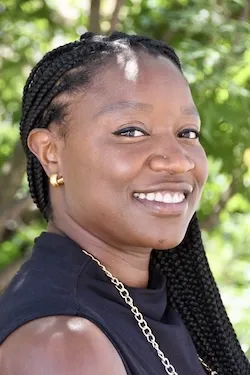
Aletha Haynes
Lower School Director
Curriculum
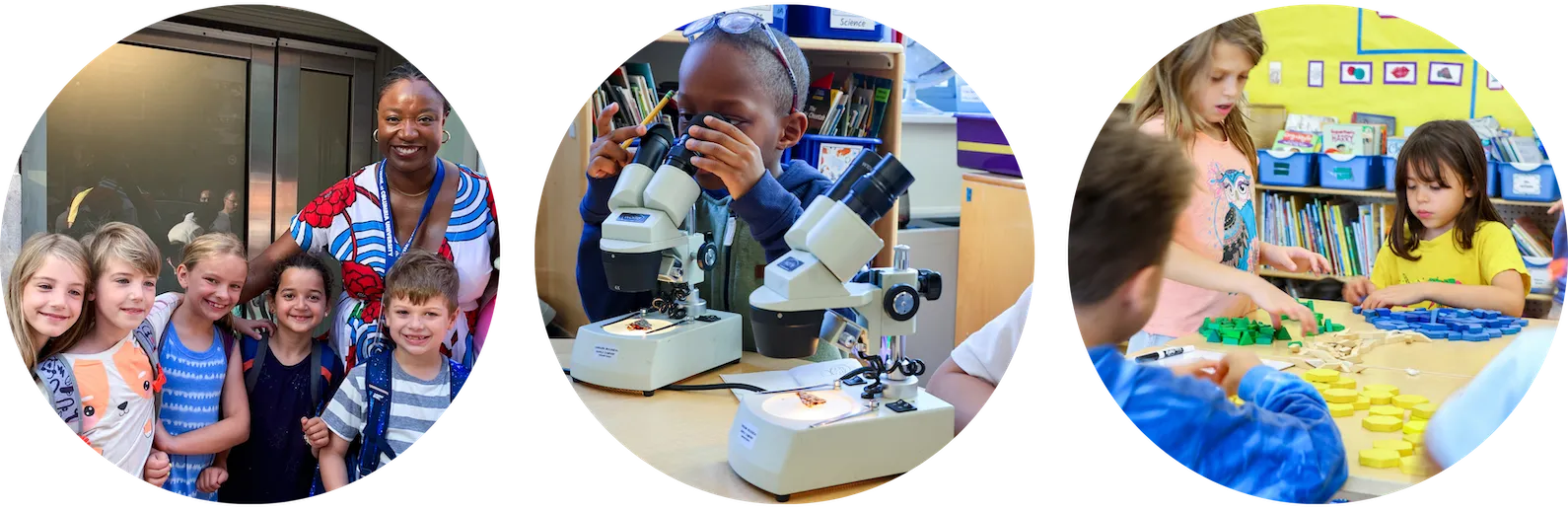
Grade-level themes and concepts are integrated across all disciplines and incorporate skills students need to acquire at each grade level:
Kindergarten
Theme: Self
Concepts: Pattern and Discovery
Grade 1
Theme: Family
Concepts: Connection and Change
Grade 2
Theme: Community
Concepts: Structure and Communication
Grade 3
Theme: City
Concepts: Experience and Movement
Grade 4
Theme: Country
Concepts: Exploration and Justice
Mathematics
The Math Program at The School at Columbia University actively cultivates confident mathematicians through a rigorous, coherent curriculum grounded in collaboration, joyful inquiry, responsive differentiation, cultural relevance, and equitable access for all learners. Students engage deeply with mathematics through a variety of meaningful applications embedded in interdisciplinary and real-world contexts. Core competency categories are:
Numeracy, Place Value, and Computation: This category builds the foundation for all mathematical understanding by developing number sense, fluency with counting, and understanding of place value. Students learn how numbers are composed and decomposed, compare and order numbers, and use place value to perform operations efficiently. Computation includes developing accurate, flexible, and efficient strategies for addition, subtraction, multiplication, and division, grounded in a conceptual understanding of the base-ten system.
Operations and Algebraic Thinking: Students develop an understanding of the properties of operations and the relationships among them. They represent and solve problems involving the four operations, explore patterns and relationships, and begin to generalize arithmetic thinking into early algebraic reasoning. This category also includes understanding the meaning of the equal sign, building toward writing and solving equations and expressions.
Measurement and Data Analysis: In this category, students measure and estimate lengths, time, volume, and weight using appropriate tools and units. They learn to collect, organize, and interpret data through graphs and charts. This category emphasizes reasoning about units, understanding measurement as a process of iteration, and using data to make informed decisions, spot trends, and draw conclusions.
Geometry: Students explore the properties and relationships of shapes and spatial structures. They identify, describe, compare, and classify shapes based on attributes, and begin reasoning about lines, angles, symmetry, and transformations. Geometry also supports spatial reasoning and connects to measurement concepts such as area, perimeter, and volume as well as early fraction concepts.
Fractions and Decimals: This category introduces students to rational numbers as extensions of the number system. Students develop a deep understanding of fractions as numbers and parts of a whole, as well as as operators, measures, and quotients. They learn to compare, represent, and perform operations with fractions and decimals, building fluency with equivalent representations and reasoning about size, equivalence, and computation strategies.
Full K-8 descriptions of curricular core competencies for our Mathematics program can be found here.
Literacy
At The School at Columbia, literacy instruction in the Lower School is built on a strong foundation in the science of reading, paired with rich opportunities for authentic reading and writing every day. Children move through a carefully sequenced progression of skills, from foundational phonics and decoding in the earliest grades to increasingly fluent, confident, and independent reading and writing by 4th grade.
Reading instruction combines explicit, systematic instruction with rich, engaging texts that build knowledge, spark curiosity, and nurture a lifelong love of reading. As students develop strong foundational skills, they learn to read increasingly complex texts with fluency and understanding, think deeply about what they read, and share their ideas through meaningful discussion and written response.
Writing instruction introduces students to a range of genres and purposes, with an emphasis on process, structure, craft, and voice. Students learn to develop and organize their ideas, make purposeful choices as writers, and revise their work with growing independence. Writing is woven throughout the curriculum, giving students opportunities to communicate their thinking and knowledge across subject areas.
Grammar and handwriting are taught explicitly alongside reading and writing, giving students the transcription and language skills they need to communicate their ideas with clarity and ease. Students learn printing in kindergarten through 2nd grade and transition to cursive in 3rd and 4th grade. As handwriting becomes increasingly automatic, students can devote greater attention to generating, developing, and refining their ideas. Grammar instruction is integrated into students’ own writing, helping them understand how sentence structure, conventions, and word choice shape meaning.
Our K–4 literacy expectations are grounded in the New York State Next Generation Learning Standards and are part of a coherent, school-wide vision for literacy that spans kindergarten through 8th grade. Teachers collaborate closely across grade levels to ensure that the knowledge and skills students build each year connect meaningfully to what comes next, preparing them to grow into thoughtful, capable, and joyful readers and writers.
The Upper School literacy program builds directly on the strong foundation established in the Lower School, guiding students toward increasingly sophisticated, analytical, and independent reading and writing. Across grades 5–8, students deepen their ability to engage critically with complex texts, develop and communicate ideas, and use reading and writing as tools for thinking and learning across the curriculum.
Reading instruction places an increasing emphasis on close reading and analysis. Students engage with complex texts across genres, examining how authors use language, structure, and craft to develop ideas and create meaning. Through explicit instruction in annotation and note-taking, students learn to identify important information, track their thinking, gather evidence, and make connections within and across texts. These practices support students as they move from understanding what a text says to developing thoughtful interpretations of how and why it works.
Writing becomes increasingly sustained and demanding throughout the Upper School years. Students write essays and other extended pieces that require them to develop clear ideas, organize and support their thinking with evidence, and attend closely to structure, craft, and voice. They learn to move purposefully through the writing process—from gathering and organizing ideas to drafting, revising, and editing—and take increasing ownership of their work as writers.
Grammar instruction continues explicitly in the Upper School, building students’ knowledge of increasingly sophisticated sentence structures, conventions, and language. Students apply this knowledge to their own writing, using grammar and syntax intentionally to strengthen clarity, precision, and style, while also drawing on their understanding of language to analyze the choices authors make in the texts they read.
Our 5–8 literacy expectations are grounded in the New York State Next Generation Learning Standards and are part of a coherent, school-wide vision for literacy that spans kindergarten through 8th grade. Teachers collaborate across grade levels to ensure that students build upon their knowledge and skills each year, preparing them to enter high school as thoughtful, analytical, confident, and independent readers and writers.
Full K-8 descriptions of curricular core competencies for our Literacy and English program can be found here.
Spanish
The Spanish Program at The School at Columbia University follows a Foreign Language in Elementary Schools (FLES) model. FLES goals, as defined by educators Helena Curtain and Carol Ann Dahlberg, are the following: “To become functionally proficient in the target language, to acquire an understanding and appreciation of the target culture and to demonstrate mastery of the subject content taught in the target language.” In a FLES model, students have Spanish for short times multiple periods a week, and the intensity increases in the Upper School.
The Spanish department at The School at Columbia seeks to foster a love of language learning and cultural understanding of the Spanish-speaking world. Faculty use a thematic approach to instruction, connecting language learning to cultural studies in meaningful ways. This integrated curriculum reinforces The School’s mission, and supports skills and concepts students are developing in other disciplines. Spanish begins in Kindergarten with a developmentally appropriate class length and frequency of instruction. This increases as students progress through the different grade levels at The School.
Spanish classes are filled with cooperative work such as performance projects, independent activities, and language games that all help foster children’s written, oral and listening skills on a regular basis. Faculty seek to create a safe and engaging learning environment where risk-taking is encouraged and participation is essential. Students begin to receive homework in Gr. 5 on a weekly basis and should expect homework regularly in the Upper School. The Spanish department supports different levels of language proficiency through heritage language learning groups and challenges, extra vocabulary and partner practice, and support for new students.
The program’s goal is that by the end of Gr. 8, students are at the novice high level in all skill areas: listening, speaking, reading and writing, as outlined by the American Council on the Teaching of Foreign Languages (ACTFL).
We have found that students who have this K-8 language exposure go on to continue Spanish and/or study other languages successfully, routinely placing into college-level language courses and earning scholarships to study abroad and in immersion camps across the country. We are proud that we have built a program to sustain that learning—a program that not only delivers National Spanish Examination performances of such high caliber, year after year, but also strengthens students’ appreciation for language and culture throughout their education.